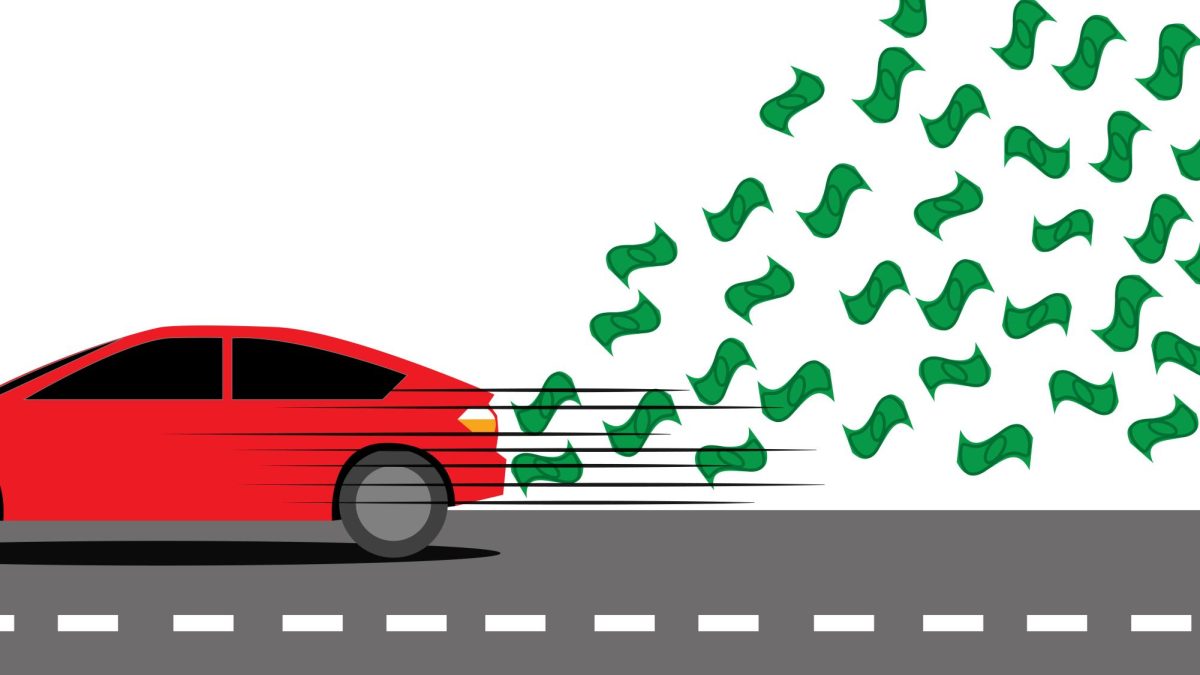
On Jan. 29, 2026, the California State Assembly voted 49-21 in favor of Assembly Bill 1421, a potential new law that would tax individuals in California for every mile that they drive. The bill proposes a new framework to potentially replace current gas taxes with a mileage-based tax. While the bill still needs to pass the California Senate before it can be signed into law, many have raised concerns about the possibility of rising costs, budgeting issues, and privacy concerns. Among these individuals are Biola professors and commuter students alike, both of whom have voiced their worries about the potential tax.
The bill containing the proposed tax follows a six month study entitled SB 339 that took place from August 2024 – January 2025. The study posits that by 2030, California will be losing around $2 billion every year as a result of citizens switching to electric vehicles. To account for this loss, the state proposed a mileage-based tax that could take the place of current gas taxes. According to the state, this would ensure that all drivers would be contributing towards the maintenance of California roads and infrastructure — as of now, drivers of electric vehicles do not pay gas taxes, which is a large contributing factor to California’s loss of revenue.
This proposed tax does not come as a surprise. In fact, Dr. Tim Milosch, a Biola adjunct professor who teaches political economy, is almost positive that this bill will get passed through the Senate and be signed into California law.
“Gas tax revenues are falling and will continue to fall,” he said. “We’ve got to find a way to keep the roads maintained, and we’ve got to find it through an alternative tax model… So I think the best option for them is to actually look for an alternative that’s more distributed across all drivers in California, and then go from there.”
Despite the fact that the bill claims that this potential new mileage tax would replace current gas taxes, current messaging from the California legislature seems to suggest otherwise. On Feb. 2, 2026, Republican lawmakers proposed Assembly Constitutional Amendment 12 — also known as the “No Double Tax” Amendment — an amendment that would guarantee that California would not double tax its citizens for both gas and mileage. However, the Democrat majority in the Assembly voted the amendment down, meaning there is a possibility that California could double charge individuals who drive gas powered vehicles.
This potential for higher costs comes at a time when California’s infrastructure continues to struggle. In the Reason Foundation’s 2025 Highway Report, California was ranked 49th out of 50 for road conditions, meaning that California had some of the worst road conditions in the country. Over 40% of California’s urban pavement was deemed as being in a state of poor condition, which is in spite of the fact that California collects the highest gas taxes in the nation. According to the U.S. Energy Information Administration, California currently has the nation’s largest gas tax, with residents paying 70.9 cents per gallon. This figure is nearly double the national average.
While the potential double tax poses problems for all Biola students, it particularly affects the commuter population. Commuters make up around 40% of Biola’s overall student population, with many of them driving from far counties every day. Many of those students expressed frustration at this tax, stating that if the state decides to charge both taxes, they likely would not be able to afford it.
“It would be an immense hit on my budget,” said Noah Lovcik, a sophomore History major. “I already have a difficult time paying for gas as it is. It takes me relatively $50-60 to fill my tank each time I do, and that takes relatively a third to a half of my budget.”
Others explained that if a double tax does come into effect, it may change how they get to campus and how often they come to campus.
“[I would] definitely carpool, or just do online honestly,” said Bethany Ruiz, a freshman Kinesiology major.
Kenneth Aguirre, a sophomore Engineering major, said it would impact his ability to participate in additional Biola activities out of class. “I would come to extracurricular events less because I would deem them as unnecessary miles,” he said.
All of the commuters interviewed agreed that, even if the state does not end up double taxing, they would still rather pay a gas tax in favor of a mileage tax, as it would be easier to budget for.
Concerns were also raised regarding privacy, with many individuals stating that they would not be comfortable with the government tracking where they are driving or how much they are driving. As of now, the state has offered three options for tracking mileage:
1) A plug-in device either with or without GPS that would track and report your mileage to the government.
2) In the case of electric vehicles, connecting directly to the car’s built-in computer through cellular systems, and extracting the information from the car.
3) Requiring individuals to upload monthly photos of their odometer to the government.
Commuter students objected strongly to the idea that the government would potentially be tracking their driving habits and mileage usage.
“I’m already being tracked enough, I don’t need the government seeing my exact driving habits,” stated Lovcik.
Milosch explained that, with all of these unknowns, California drivers should be concerned.
“I don’t know the data on, say, average miles driven, or what the price structure on this tax would look like, so I think for those unknowns and the possibility that there could be a double level of taxation for someone driving a gas powered car, I’d be worried,” he said. “I’d be calling your representative about that… because, yeah, there’s a potential for really difficult costs being borne by the average driver in California as a result of this.”
“It doesn’t have to be that way,” he added, “but there are definite risks.”
In spite of these fears, commuters generally acknowledge that they would not have a problem with the tax so long as they are not double taxed and the issues regarding privacy concerns are addressed.
“I would have to look at what the current gas tax is and do some calculations on its price per gallon, and then compare that to the price per mile of the mileage tax,” said Aguirre. “If they were similar, then I would be okay with it.”
As of now, there is no specific enforcement date for this proposed tax. However, the California Transportation Commission is required to have a finalized plan and report submitted by Jan. 1, 2027. Following this report, the Legislature will vote on the tax. If it passes with a two-thirds majority, California could begin to see implementation take place by late 2027 or early 2028, and the full integration of this tax by 2035.