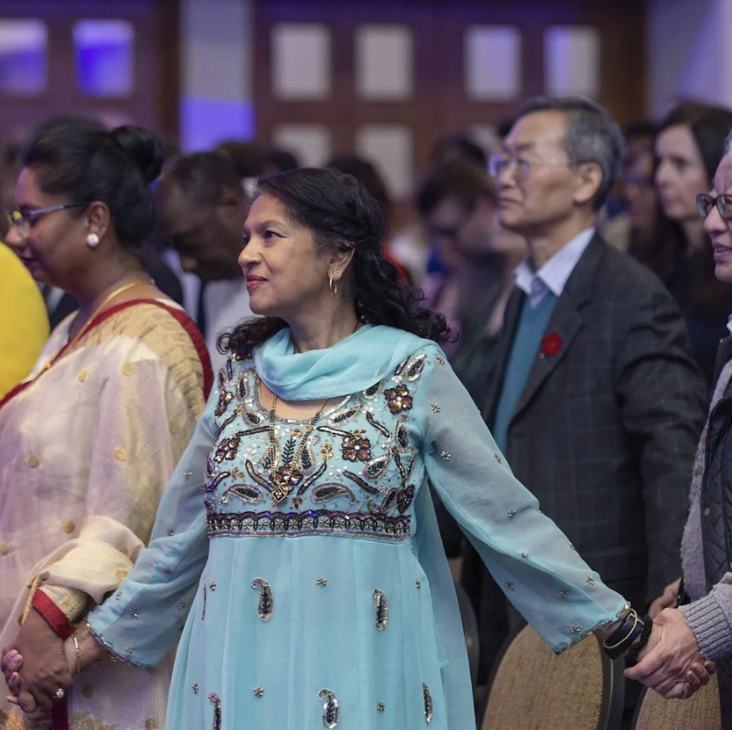
For this year’s Missions Conference, themed “Children of Light,” SMU has invited Usha Reifsnider to speak on her experiences as a Christian who converted from a Hindu background. She seeks to give insight into how other cultural groups, like Hindus, might interact and respond to the Gospel.
USHA’S CALLING TO BIOLA
As both an academic and follower of Christ, Usha draws on her background in missiology, theology and cultural anthropology to help bridge cultural and theological divides within the church.
Usha explained that the invitation to speak at Biola initially came from Talbot School of Theology Dean, Dr. Ed Stetzer, whom she works alongside at Lausanne.
According to Usha, she “almost jokingly said, well I could do it…I’m not famous. I’m not, you know, sort of massively published, but I’ve been following Jesus since the age of 11. I believe I had a court admission at the age of 10. I grew up in a Hindu home. I read the Bible. And therefore, I think the thread of cultural anthropology, missiology, and theology has been a part of my lifelong study. Perhaps I have something that the students of Biola may not have had a chance to consider before.”
While she does not consider herself to be a majorly prominent figure, Usha believes that her experiences—her life—have the potential to unearth new perspectives and insights on Biola’s campus.
She highlights how Biolans—just like any other institutions’ students—are studying a wide range of subjects, and as we do so, our cultural worlds are inadvertently becoming more informed.
Usha says, “So as your cultural world is being informed, it’s pulling on your theology and it’s pulling on your idea of what missions is, and missions is pulling on your cultural anthropology, and those are pulling on your theology.”
Through the limited time she has at Missions Conference, Usha will prompt students to further reflect on how these various aspects are interconnected and actively working in our lives, and in the body of Christ.
BREAKING BARRIERS IN MISSIONS
While Biola is filled with college students studying theology and engaging in Christian spirituality, there are still barriers that persist within our missions and overall ministry. A primary example of that being cultural barriers. Usha, being subject to these barriers throughout her life, has important insights into how these cultural dissonances might be overcome.
While Biola has a fairly diverse student body, a significant portion of Biolans are white and domestic students. With that in mind, Usha found it important that she preface her discussion on interculturality with this note:
“God didn’t make a mistake when he created me as a small brown woman [raised] in the Hindu family. And God didn’t make a mistake when he created millions upon millions of white British people, white English people…That’s not an error on God’s part,” said Usha. “We don’t have to undo something that God clearly created; however, what we do need to think about a little bit more carefully is that there is a reason we only have partial vision.”
She believes that, while God’s creation of each and every individual is not a mistake, the ways in which we evangelize and pursue missions have flaws. And it is because of those flaws that we have deprived ourselves of the ability to fully see the church, or more appropriately, envision the intercultural church. So, although Biola is dedicated to using their biblical studies and theology for missions, there are factors we need to stay cautious of and attentive to, both on and off campus.
Usha says, “The problem occurs when we think that one language, one culture, one period in history is the ultimate. Because God is infinite and he’s timeless. And so in that timelessness of God, there is room for so much more than what’s happening in the 21st century in 2026 Biola. God is infinitely more than that. If that’s all that we could capture God to be, he would be nothing more than a political ideology meant for a specific time in history. But God is bigger than that.”
BEARING BURDENS AND SHARPENING IRON
Usha went on to discuss certain actions we can take and specific ideologies we can uphold, in order to avoid having this partial vision.
Bringing Scripture into the topic of interculturality, Usha speaks about “bearing one another’s burdens [Gal. 6:2], which speaks as a sort of unity…[and] another Scripture that says iron must sharpen iron [Prv. 27:17], which sounds almost the opposite…however, we all want growth and you can’t have growth without energy, and you can’t have energy without friction.”
In other words, Usha highlights how a foundational aspect of missions (or any form of ministry) is bearing each other’s burdens. It is how we can unite the church amidst dissonance, and grow the body of Christ; however, we must learn to sharpen one another if we wish to effectively do so.
Usha critically notes that, “as students go out from Biola, they will have the opportunity to take what they have learned, and use it, and sharpen it. And that will bring them into the paths of other people that have not been at Biola, that are not living in America, that are not the same age as them, the same race as them, the same economic standing as them. And in that space, you’re not just bearing the burdens of somebody who’s like you, but somebody who’s not like you, simply because they’re a part of the body of Christ.”
Through Usha’s short time here at Biola, she hopes not only to offer us her time and knowledge, but also a space to consider how missions and ministry are impacted by our culture. Her ideas will allow us to reflect on how we can free the Gospel from being monocultural, to being intercultural by pointing to a pivotal moment in Scripture, and in history, where this idea was actualized.
“Suddenly at Pentecost…[there was] no more covering, now it’s redemption. No more just one person behind a veil, now it’s Jesus sacrificed free for all,” said Usha, “God broke out of a box (literally) at Pentecost, and we’ve spent 2,000 years trying to put him back in one.”
In light of this remark, let us consider how culture has played into our evangelistic efforts, and anticipate learning more about intercultural theology from Usha at Missions Conference.