Biola is set to launch its new School of Arts and Letters (SoAL) in the Summer of 2026, joining together the current School of Humanities and Social Sciences (HSS) and School of Fine Arts and Communication (SOFAC). The change will occur as Biola is in the process of developing its new core curriculum, expected to take effect in the Fall of 2027. Dr. Todd Guy, the current dean of SOFAC, will serve as the new dean of the School of Arts and Letters.
On Thursday April 16, Biola students from the two merging schools were invited to a student forum hosted by Dr. Guy and three other associate deans to learn about the new School of Arts and Letters and voice any concerns about the change. The evening highlighted the advantages posed by the new school, including a strengthened and more cohesive liberal arts focus and increased interdisciplinary potential.
One of these interdisciplinary initiatives will be a new Politics, Philosophy and Economics (PPE) major to be directed by Dr. Matt Van Hook, who will also assume a new role within SoAL as the Associate Dean for Strategic Initiatives.
In addition to the integrated PPE major, SoAL also hopes to add new architecture and interior design programs to its catalogue of fine arts offerings. Currently, California Baptist University is the only Christian university in California to offer either an architecture or dedicated interior design major.
BEHIND THE SCENES
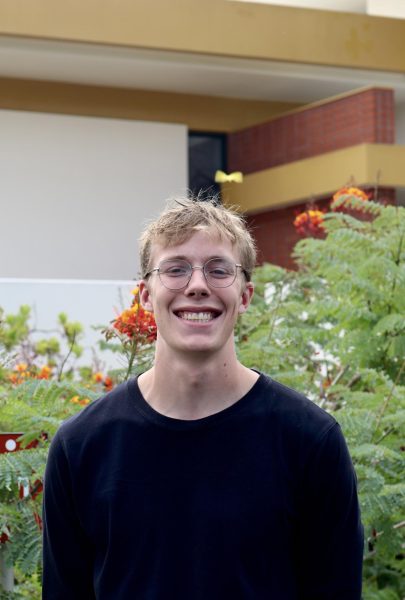
Throughout the departmental shifts involved in this merge, including the departure of the former dean of HSS for an elevated administrative role, one humanities professor and a new Associate Dean for the School of Arts and Letters has been working behind the scenes, keeping the ship afloat. I sat down with Dr. Aaron Kleist to ask about the reasons behind these programmatic shifts and what led to the decision to launch SoAL. He began with a question of his own.
“How familiar are you with the demographic cliff?”
Beginning with the outset of the financial crisis in 2007, birthrates across the nation have steadily declined for the last several decades with few signs of recovery. The so-called “demographic cliff” refers to the resulting decline in high-school graduates expected to begin in 2026, as adolescents born after the recession begin to turn 18. Already universities are beginning to feel the contraction in the number of college applicants, with some experiencing departmental or full institutional closures.
The demographic cliff looms large for every university administration, but especially those like Biola’s whose primary undergraduate pipeline comes from California, a state with one of the deepest predicted dropoffs. According to a 2024 study by the Western Interstate Commission for Higher Education (WICHE) the number of graduating high school seniors in California is projected to drop 29% by 2041, compared to a national average projection of 13%.
Californians make up nearly 70% of Biola’s undergraduate population.
“For all of our marketing, our Biola admission numbers very closely parallel the number of students graduating from California public high schools,” Kleist said.
Another important element of this trend is the “admissions funnel,” which refers to the proportion of prospective students who show interest in a school and the number of those who actually enroll. Dr. Kleist commented that Biola has been blessed with a narrowing admissions funnel, despite a national trend among college applicants towards a more diversified college search process.
“While there have been fewer applicants, that funnel is narrower,” Kleist said. “So far, the yield has been on budget and those who have expressed interest are coming. We don’t take that for granted at all.”
Still, the approaching demographic cliff puts a substantial degree of financial pressure on university administrators. At Biola, one of the solutions has been a broadened involvement in the enrollment process and recruiting efforts. That means faculty and staff, especially department chairs, have more to do as they work more frequently alongside the university’s enrollment management and marketing teams.
“There’s been an appropriate new sensitivity toward those [admissions] numbers,” Kleist said. “All across the board– in all the departments– one of the messages is, ‘We’re all in the enrollment business.’”
THE ACADEMIC IMPLICATIONS
At the same time as these financial pressures are being anticipated, Biola has begun the process of developing its new core curriculum. As a part of that process, the former dean of the School of Humanities and Social Sciences (HSS), Dr. Melissa Johnson, was brought on as Associate Provost of Undergraduate Education and tasked with overseeing the implementation of the new core.
According to Kleist, there is a current proposal for a new core of roughly 30 units making its way through the curriculum committees. The current plan would be to finalize this proposal for implementation by the Fall of 2027, but there are still several steps required in order to meet that target.
“Let’s say it’s a strong stated goal,” Kleist said.
A total reworking of Biola’s core curriculum will have widespread effects across the university, but nowhere more than SOFAC and HSS especially, whose six departments – English, History, Modern Languages, Philosophy, Political Science, Sociology – are all bound up in the current core. The merging of the two into SoAL will consolidate the majority of the core curriculum under a single school.
This is expected to allow for a more streamlined student experience surrounding the core curriculum, as well as foster more interdisciplinary teaching.
“Interdisplinarity is increasingly valuable,” Kleist said. “Programs and partnerships that transcend disciplinary boundaries are increasingly prized.”
An increased emphasis on interdisciplinary teaching reflects both the need for fiscal efficiency, which the university is all the more attuned to, as well as the instructional theory behind the construction of the new core curriculum.
“New core? Even that phrase demands the exploration of connections,” Kleist said. “If you’re going to do this programmatically, and it’s all in splinters, that doesn’t make any sense.”
In that sense, SoAL is expected to facilitate a more connected and interdisciplinary undergraduate core curriculum. Biola’s Provost and Senior Vice President Matthew Hall affirmed that interdepartmental collaboration and core integration were among the advantages offered by the merged school, as well as resource efficiency and avoiding administrative duplication.
As the development of the new core curriculum urges Biola to think interdisciplinarily, and the approaching demographic cliff demands a degree of financial efficiency— the new School of Arts and Letters, set to launch this summer, is the latest change to Biola’s undergraduate academic offerings.
“This is a great opportunity for professors who already share interests in common– and friendships and relationships– to leverage those in new curricular terms to help students make sense of how the pieces of their education connect,” said Kleist.