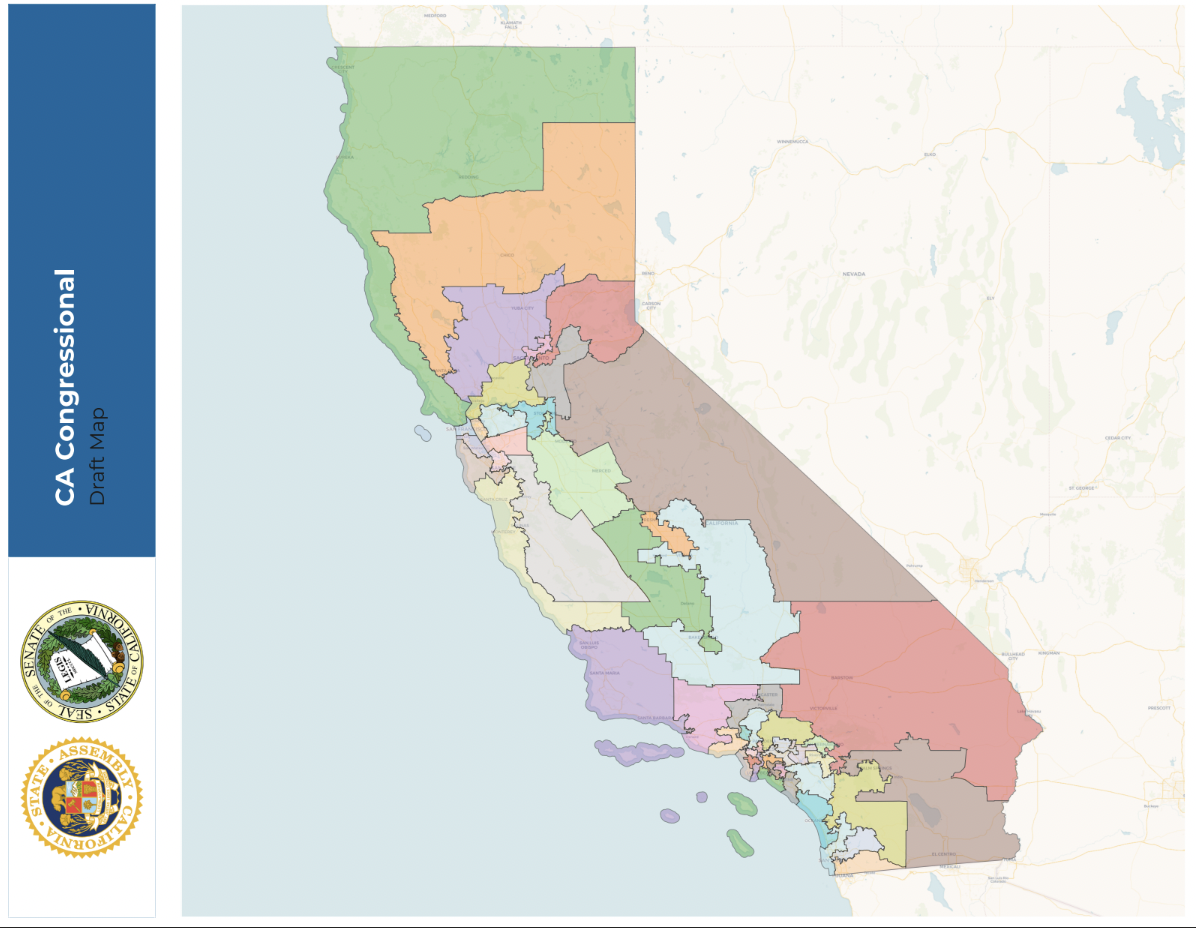
Last night Californians voted to approve Proposition 50, a measure backed by Governor Gavin Newsom to allow for partisan redistricting across the state of California.
The win for Californian Democrats arrived alongside a wave of victories across the country for the party, including New York city’s mayor-elect Zohran Mamdani and Virginia’s next governor, Abigail Spanberger.
The statewide vote came at a time when many Californians, unhappy with President Trump and his agenda, have taken to voicing their opposition at nationwide rallies, such as the recent “No Kings” protest in downtown Los Angeles.
However, Governor Gavin Newsom and California Democratic leadership has chosen a different strategy with Prop 50. The measure approves a constitutional amendment allowing California to redraw the state’s congressional-district map for the important midterm elections in 2026.
Normally this map is drawn by a bipartisan committee called the California Citizens Redistricting Commission (CCRC) once every 10 years. The new Prop 50 will temporarily allow congressional district maps to be drawn by the democrat-controlled California state legislature until the next census in 2030.
For Gov. Newsom and Prop 50’s proponents, the measure is about much more than just who holds which seats in California. As part of a larger plan to secure Democratic control of Congress, it has the potential to affect the tide of national politics and shape the future of our country.
WHY DOES THIS MATTER?
While the details of who draws congressional district maps may seem unimportant, in reality, they can be a powerful political tool. Districts can be “gerrymandered”, manipulated to favor a certain party or class, which can give some an electoral advantage over others. In response to particularly blatant racial gerrymandering in the 20th century, the Voting Rights Act was passed, limiting how states can redraw their maps. However, despite restrictions, gerrymandering still occurs often in both Democratic and Republican controlled states.
Critics of Prop 50 argue that it is simply another partisan maneuver to secure power under the guise of reform. But its supporters, including Gov. Newsom, see it as a necessary countermeasure—a way to balance Republican-led redistricting efforts across the country.
Earlier this summer, Texas and several other states unveiled their own new redistricting strategies which caused their fair share of controversy. In Texas, the new plan has the potential to give Republicans five new seats in Congress come the midterm elections next year. According to state officials, this was all done at the President’s urging to secure a Republican congress through the rest of his second term.
In response, Gov. Newsom and his supporters have decided to fight fire with fire. In his support of Prop 50, Newsom cast it as a tool for fighting back against President Trump.
The redrawn districts aim to diminish and dilute Republican voters’ power, in one case by uniting rural, conservative-leaning parts of far northern California with Marin County, a famously liberal coastal stronghold across the Golden Gate Bridge from San Francisco.
“Both the proponents and opponents admit that this is in response to national politics,” says Dr. Darren Guerra, a Professor of Political Science at Biola. “If all goes according to plan, the new map could swing the House back to Democrats. Even the commercials have Barack Obama saying ‘this is your chance to stick it to Trump.’ It’s effective messaging.”
Some see Prop 50’s victory as a win for those fighting against President Trump and as a last resort measure when other states are doing the same thing. Critics have said that two wrongs don’t make a right even if they aren’t happy with the President’s agenda.
Lauren Gonzales, a sophomore philosophy student, voted against the initiative.
“I was concerned that even if it’s necessary, gerrymandering isn’t the right thing to do,” she said.
Although the full effects of Prop 50 won’t be seen until the 2026 midterms, its implications stretch far beyond California. The initiative symbolizes a new tactic of political warfare: one where principles of nonpartisanship in redistricting are increasingly sacrificed for short-term power.
California has long prided itself on pioneering progressive reforms, from environmental policy to voting rights. Yet Prop 50 blurs that image, forcing democratic voters to weigh idealism against pragmatism.
As the nation watches the Golden State redraw its map, the message is clear: in today’s polarized America, even the lines on a map have become a battlefield. The question now is whether this is an act of democratic defense or partisan escalation?