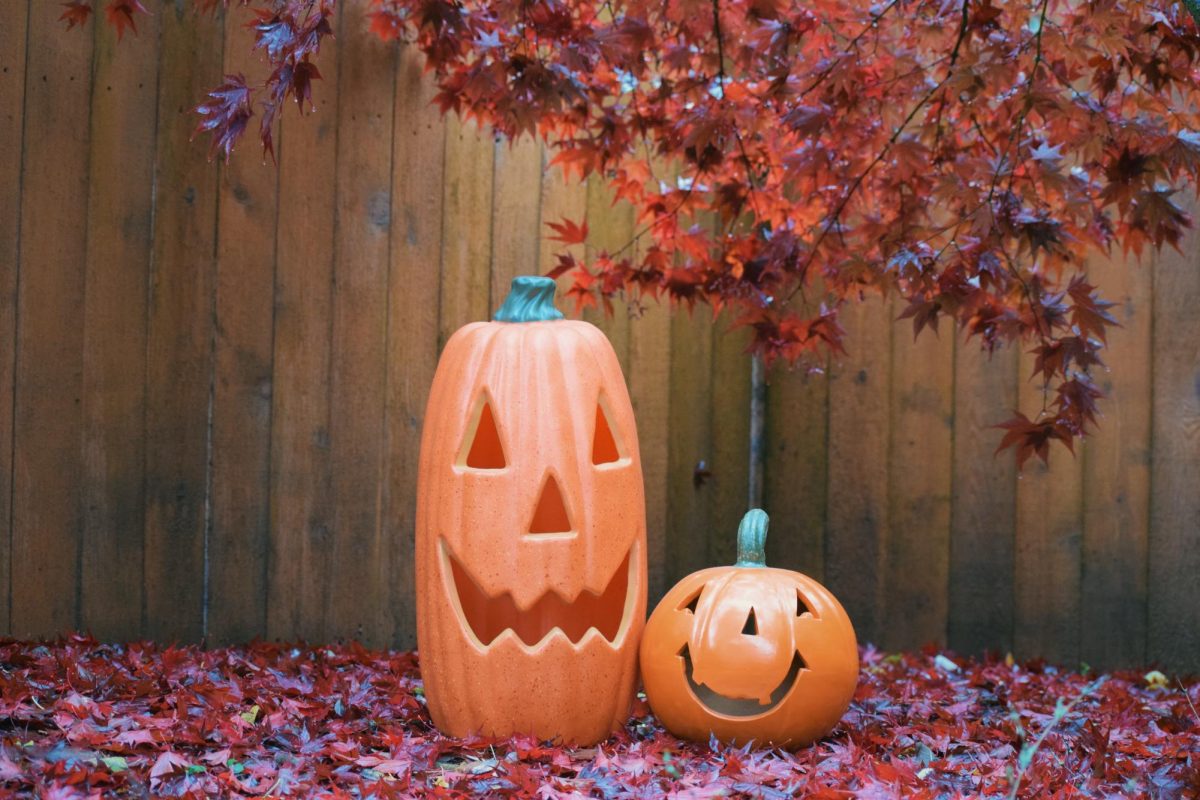
Three knocks to the door of our conscience, each and every year—on the other side of our soul’s door, three words followed by the open arms of an unsolicited, yet familiar guest:
“Trick or treat!”
Is it an invitation, a trick, to halt our faith and hail the annual felicitations of a more devilish genesis? Or, is it an invitation to share the even holier treat of the carpenter-born Messiah? These are the questions on the young Christian’s mind, each and every Fall—the question of a fall.
Is it alright—no, is it Christian—to celebrate Halloween?
A TRICKY ORIGIN STORY
While the birthplace of a worldwide phenomenon like Halloween is tricky to tie to one specific time or place, it can be inferred that the holiday had less-than-Christian origins. Today, especially, the holiday boasts of less-than-Christian values: individuals take the time to dress in revealing costumes, engaging with content that promotes vices like murder and witchcraft.
Most notably, The Library of Congress attributes Halloween’s origins to Samhain (to those who have yet to brush up on their Gaelic, it is pronounced “SAH-win”), an annual Celtic festival which celebrates the end of summer and the start of the winter season. Celebrants believe that, during this period of growing darkness, the barrier between the spiritual and physical world grows thin, and spirits of the departed can enter into our own.
In order to confuse and ward off these unsolicited visitors, celebrants of Samhain would dress up in costumes made from animal skins. Offerings were placed on banquets tables located in public spaces to pacify angry spirits. But soon, individuals even began to dress up in ghoulish livery of their own, putting on shows and dances for food or drink. This practice came to be known as “mumming,” a predecessor to “trick or treating,” according to the HISTORY channel website.
According to the ARLT blog, an association for teaching Latin, it was only after the Roman Empire conquered the Celtics in 43 AD that the celebration grew more recognizable features to the Halloween holiday that we’re familiar with today.
Roman and Celtic cultural practices merged — most notably, the Celtic festival of Samhain was assimilated into the Roman festivals of Feralia and Pomona: a celebration of the dead, and a dedication to the goddess of agriculture and abundance, Pomona. Celebrants of these festivals played an especially recognizable Halloween activity: bobbing for apples. Though, at that time, the activity was more a courting ritual than a game of skill.
THE QUESTION OF CHRISTIAN ORIGINS
According to the Today’s Catholic report on Halloween’s more religious origins, the Christianization, or supposed Christianization, of Halloween began at the hand of one Pope Boniface IV in 609 AD. After re-dedicating the Pantheon, a Roman temple originally dedicated to the gods, to all Christian martyrs, Pope Boniface IV established a spring festival known as “All Martyrs Day.” The annual dedication to martyrs of the faith stood on the date of May 13 until it was pushed farther into the year by Pope Gregory III in 735 AD, after he dedicated an oratory, or small chapel, in Saint Peter’s Basilica to “apostles, martyrs, saints, and confessors.”
The celebration, now on Nov. 1st, fell right smack in the middle of Samhain festivities, and included a time of dedication to all martyrs and saints of the faith. This celebration came to be known as “the feast of All Saints,” or “All Saint’s Day.”
Eventually, the celebration spread to churches outside of St. Peter’s Basilica, and Pope Gregory IV officially proclaimed “All Saint’s Day” as a holy day in all the Latin church. The celebration now included both a feast on the 1st of November, as well as a vigil the night before, to reflect and pray for the fallen. That time, specifically, came to be known as the “Vigil of all Saints,” or the “Vigil of all Hallows.” Though, the name that stuck around the longest was that of “All Hallows’ Eve.”
After the vigil, the festivities would begin. Christians would feast and visit graveyards, offering intercession for the saints. Notably, children and the poor began going door-to-door, asking for food and drink in exchange for prayers to the departed. This practice came to be known as “souling,” and it bears many similarities to the Celtic practice of “mumming,” or the modern ritual of “trick or treating.”
Soon, the Church dedicated the 2nd of November as a day to honor all departed, which has come to be known as “All Soul’s Day.”
SECULARIZATION IN THE STATES
With time, the celebration eventually made its way to the States. In the New World, these times of dedication to the dead were more secularized, or without religious or supernatural influences. For example, instead of “souling,” Scottish settlers would dress up in costumes and go door-to-door telling jokes, singing songs, reciting poetry, or dancing in exchange for food and wine. This practice, known as “guising,” is one of the first instances of “trick-or-treating” in the New World.
According to a report by the Austin-American Statesman News Group, a blend of European and Native American cultures in the 19th century led to even more changes to these festivities. Celebrations were focused less on the departed, and more on the living: parties, dancing, and fortune-telling were staples in these now-public community events. By the 1920s, the ritual of “trick-or-treating” was a Halloween staple in these communities, but it was soon halted due to sugar rationing during World War II.
The end of the Second World War, and the desire for more congenial living, led to the migration of families into suburban communities. There, the holiday became a celebration dedicated to the young. Candy companies even began packaging individually-wrapped candies for parents to hand out door-to-door.
By then, the celebration had shed all semblance of its religious and supernatural influences. Though the practices remained, they were charged with a more secular purpose. Ghost stories around a bonfire replaced fervent prayers for the dead. Professor of Anthropology at Syracuse University Chris Decorses even asserts that the Headless Horseman, a character from Washington Irving’s short story “The Legend of Sleepy Hollow” who dons a Jack-o-Lantern for a head, made the pumpkin a staple of the holiday celebration, replacing the Irish tradition of turnip-carving. The Jack-o-Lantern, especially, is rooted in Irish folklore. According to a report by the Carnegie Museum of Natural History, the carving tradition comes from the tale of Stingy Jack, who was cursed to roam the Earth after cheating the devil, with nothing but the faint flame of a candle inside of a carved turnip to light his way.
Today, Halloween is an annual staple of commercialized fun and mischief, present everywhere from movies to even theme park events. The holiday now belongs to the world, and is no longer attached to any cultural or religious peoples.
Of course, many cultures still follow more spiritually-guided celebrations. Latin American and Mexican communities, for instance, celebrate “Dia de los Muertos,” a time for families to pay respect for their departed ancestors. Cambodia, too, celebrates the festival of Pchum Ben around the October season. Cambodians take this time to mourn the departed, of up to seven generations, in a fifteen-day festival full of food, fellowships, and prayers.
Despite the physical boundaries between cultures and religions, the liminal space between the Fall and Winter seasons continues to be a point of intrigue for many. The shift between a harvest of life, to a period of cold death, perhaps, leads many to reflect on their departed, and their own morality.
A DEVIOUS TRICK, OR AN EVANGELICAL TREAT?
Can Christians still participate in a celebration with pagan origins, without attributing themselves to those pagan beliefs? Or, is this holiday merely a trick up the devil’s own sleeves to push us Christians to sin by our sweet tooth?
Many Christians are of the impression that this is the case. A survey conducted by the Christian Broadcasting Network (CBN), found that over 87% of believers are of the opinion that Christians shouldn’t celebrate Halloween, while 13% don’t think anything of it.
Similarly, a poll by The Associated Press-NORC Center for Public Affairs Research found that two-thirds of Americans will celebrate Halloween in some way this year. Of these, parents with children under 18 are most likely to celebrate, indicating the commercialization of the holiday, especially towards children.
Halloween is spiritually charged, regardless of which direction you lean. But, its more pagan influence shouldn’t be enough to deter anyone from the festivities. By that logic, any and all institutions with pagan influences — weekdays, birthdays, and even wedding rings — should be avoided. Of course, it’s also hard to ignore Halloween’s current focus on the occult and chainsaw-wielding vice.
To the Christian torn with the question of whether their choice to dress up as Spiderman will expel them from Heaven’s pearly gates, the words of Paul are key: “‘All things are lawful,’” he notes, “but not all things are helpful. ‘All things are lawful,’ but not all things build up” (English Standard Version, 1 Cor. 10.23).
So no, you won’t go to Hell for dressing up as Spiderman for Halloween, but your faith also shouldn’t be hidden when you put on a mask.
On a night where the darkness is at its height, it’s easier than ever for the light of our faith to shine. Many churches have taken advantage of Halloween festivities, offering alternatives to the more secular practices like trick-or-treating. “Trunk or Treats,” block parties, and other events are also used as outreach opportunities. Christians can still participate in Halloween-related festivities without necessarily celebrating its pagan origins.
But the question of the individual is just as important. Someone is knocking on your door— that much is sure. It’s your work to decide how you will respond. However you celebrate the holiday, ensure that it’s one where your Christian light shines.