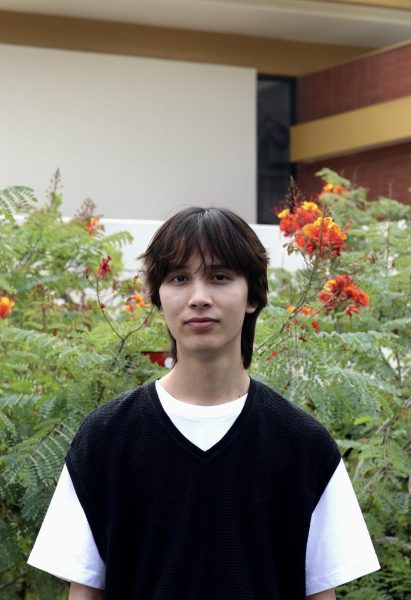
Talbot professors play a central role in Biola’s community as they dedicate themselves to guiding students through their biblical studies, spiritual life and more. These professors offer their time, energy and knowledge to pour into countless students, and while they are often purely seen as educators and academic advisors, they also are our brothers and sisters in Christ who bear the same questions and doubts that we have about the Christian faith.
CARMEN IMES
I had the privilege of interviewing Associate Professor of Old Testament Carmen Imes, who told me her testimony and showed me some of the most intimate corners of her walk with God.
Having barely started the interview, I was met with the unfiltered love and deep admiration that Imes has for God. Upon asking her at what point she came to truly accept Jesus as her Lord and Savior, she said three years old, without hesitation. She explained how she vividly remembers sitting on her bed as a little girl, praying to God and accepting Jesus into her life.
“I think there must have been something that clicked, that I wanted to follow Jesus just like my parents did. You know, it’s my parents who really shared the gospel with me in my household, and I knew I wanted what they had. I wanted to be a part of it,” said Imes.
From as early as she can remember, Imes has always yearned for a relationship with Christ.
But for several years after she accepted Christ, she struggled to understand the full extent of what her prayer as a little girl meant.
“I kept thinking that I needed to accept Jesus all over again, because the first time I didn’t know enough, and each time I learned more about God, I would be like, oh, I need to do this again,” said Imes, “I don’t remember exactly what age I was, but maybe around fifth grade, [and] somebody said, ‘Carmen, you don’t need to do this over and over again—God’s grace covers your lifespan. And it’s not about how much you know and understand, you’ve surrendered, and that surrender can grow with you as you grow.’ And I remember that being freeing, that I didn’t have to have it all figured out.”
For much of her childhood, Imes experienced a tension that many of us feel throughout our lives: a struggle to realize the immensity and profoundness of God’s grace. She explained, however, that once she acknowledged how vastly Christ works through our surrender, she was set free from the worry that she wasn’t meeting God’s expectations.
Much of her testimony reflects that revelation. In her 27 years of marriage, she has moved 16 different times. With each move, she and her family had to reconsider which church to attend. Even when she wasn’t moving across different parts of the world, she still found herself changing churches. Throughout these shifts, Imes explored diverse denominations. In being exposed to various theological and doctrinal beliefs, she came to learn something crucial about the Christian faith.
That is, “[It’s most] important that we walk faithfully with God and live well with each other. I don’t think that when we get to the pearly gates, there’s going to be a doctrinal questionnaire,” said Imes, “I think if we have surrendered our life to Jesus, then the atonement did the thing it was supposed to do, even if we personally can’t describe all the facets of it.”
She believes that, above doctrinal certainty, surrender and obedience should be at the center of a person’s religious life—her own included. And there are many ways in which she has endorsed these values, but one of the most prominent ones is her passion for missions.
“I’ve always had a heart for missions, since I was eight years old,” said Imes, “My whole life has been organized around ‘what does it look like to invite other people in?’”
Even now she holds a vocation for missions. She explains: “I think recently, God has been reigniting my desire to connect with unbelievers and invite them in, and writing a book on the church has been part of that. Just seeing [how] God has created something so special for us…I hate it that there are people who are missing out.”
From that time she was a little girl praying on her bed to Jesus, to the present moment, Dr. Imes continues to seek the Lord and pour her heart into loving him.
JONATHAN LUNDE
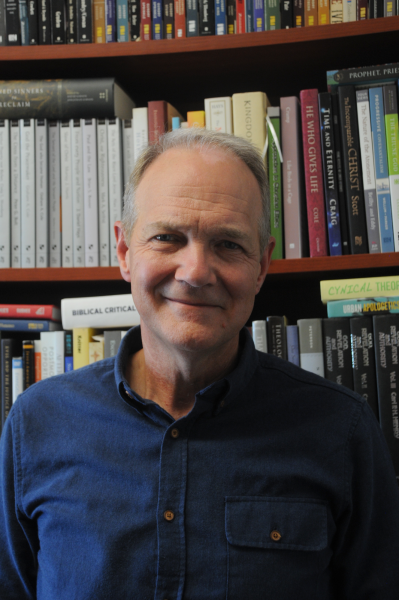
As Christians, we may reach a point in our lives when we recognize our utter dependency on the Lord. We can’t help but express, from our hearts and our mouths, that Christ is our Savior. Professor of New Testament Jonathan Lunde—whom I also had the privilege of interviewing—explained how this is a conviction that he holds everyday.
“Most days, before I do anything, I spend time in prayer on my knees,” said Lunde. “One of the first things I do is confess that Jesus is risen, and he’s seated on the throne today and I enter the day with that conviction that Jesus is alive, that he is the king over the universe and that he reigns over my life, so that I encounter the day under his authority.”
For Lunde, the belief that Jesus is our Savior is more than just an ephemeral sentiment, but a lasting conviction that he acknowledges daily. However, this active and fervent faith was not something that has always existed in his life.
Raised in “a mission oriented, gospel grounded home,” Lunde accepted Christ into his life early on. It was at the age of nine that he realized his need for grace and declared his faith in Jesus.
It wasn’t until his junior year as a student at a state university that he began to struggle in his walk of faith. It was there that he became exposed to atheistic and pluralistic views, and even began subscribing to an agnostic worldview.
“I wanted to continue to believe, but I just couldn’t, and I scorned Christian faith,” said Lunde. “It was a really, really dark time, and the closer I got to atheism, the more I was immersed in despair because of the meaninglessness of the world, of my life [and] everything just threatened to completely suffocate me.”
After falling into this spiral, he reached out to a former pastor to process this crisis of faith.
“I then began to wrestle with the resurrection, begrudgingly, I began to realize the case for its occurrence was stronger than for its non-occurrence, as hard as it was to come to grips with,” said Lunde.
And as the validity of the resurrection became progressively more plausible to him, Lunde came to rediscover his need for Christ.
“I was on my knees, having been convinced now that the resurrection happened. I surrendered to the foolishness and the stumbling block of the gospel, and that’s where I’ve stood ever since,” said Lunde. “The resurrection is what I would call my bedrock faith. If it happened, Jesus is right…If it didn’t happen, we might as well all go home, because Christianity is not true.”
In a state of despair and heavily questioning the basis of Christianity, Lunde was brought back to his confidence in Christ through a conversation with his former pastor and what could be deemed as an encounter with the Holy Spirit.
His faith isn’t perfect or untouchable, none of ours is. Just like the rest of us, Lunde faces doubt in his beliefs. However, this doubt is not enough to deconstruct his faith.
He said, “The more I think about the Christian worldview, the more I’m convinced it is the superior one to every other worldview. It’s the one that makes [the] most sense out of our own experience as humans…It also explains why this thing is here, the universe is here. It explains why there’s so much design. There’s so much Telos [fulfillment] to it. There’s a goal, there’s a purpose to things.”
As humans, it is undeniable that we are driven by purpose. We spend our entire lives striving for various things, whether it be an education, career, or relationship. Lunde expressed that this longing for purpose and accomplishment, it isn’t a coincidence. It is something that God embedded into Creation. And that is one of the main reasons why he places his confidence in the Christian worldview: it resonates with our nature.
As the years pass by, Lunde finds it increasingly important to hold these truths about the Christian worldview close to his heart. And he exhorts others to do so as they live in relationship with Jesus.
“Both aspects of Jesus’ life and death are equally important,” said Lunde, “That he took the death that I should have died, and I received the full credentials of his righteous life. And what that does is it liberates me from legalism. It liberates me from shame. It liberates me from the need to constantly try to perform. Why? Because I live in Christ.”
ENGAGING AFRESH
In light of these intimate and unfiltered testimonies, I want to encourage the students of Biola to reflect on the relationships and dynamics they have with Talbot professors.
From now on, let us engage with our Talbot professors afresh by connecting with them in ways that go beyond academia. Rather than merely coming to them for an education, allow us to partake in communion with them. We should recognize that, while it may not seem like it, these professors bear the same questions and doubts that we have, because just like us, they are children of God who grapple with the issues that inevitably come with a broken and sinful world.
As we further our time here at Biola, let us seek ways that we can treat our Talbot professors, not just as educators, but as our brothers and sisters in Christ.