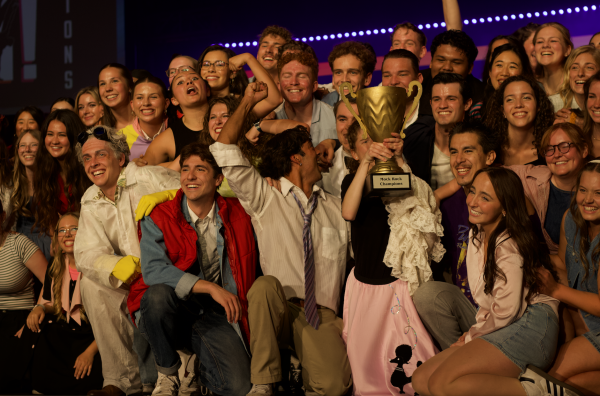
On Friday April 10, Biola’s annual lip sync competition returned to see four classic teams joined by one new face— team Reflex. The night saw outstanding performances by each team, Encore with a Men in Black themed number, Heroes with a version of Shrek 2, Men of Honor’s take on Alice in Wonderland and Bropoc’s original Grand Magician story, but Reflex’s rendition of Back to the Future, complete with their own DeLorean, stole the show in their debut appearance.
Mock is one of Biola’s favorite traditions and one of its most intense. For anyone who wants to understand the Mock Rock hype, attending a practice is mandatory.
“Guys, this song has so much aura,” Reflex choreographer Zac Siewert shouts to the squadron of sweaty dancers in front of him. Siewert has dance experience but this year marks his first time in an official teaching role. “This song exudes ‘I’m driving in a Lamborghini,’” he says, hoping to coax the swag out of his dancers. He presses “play” on his phone and music blares from the giant speaker next to him.
Right on cue and with a militant focus, each row of dancers on the concrete stage of the parking garage floor repeat the choreography for probably the thirtieth time of the night. Students’ arms flail and feet kick, closely missing contact with the dancers around them as they wrestle to master the new moves.
Throughout the course of a Mock Rock season, dancers will spend over 70 hours at practices, which usually take place around 9 p.m. after classes and other obligations have finished for the day. Reflex claims the top floor of the Horton parking garage as its practice turf, but teams will practice anywhere on campus, including vacant classrooms. Although intense, this type of dedication is warranted considering each team’s final performance will be 8-10 minutes long and scrutinized by thousands of their peers packed into Chase Gymnasium.
A NEW TEAM
When the 2026 Mock Rock season kicked off in mid January it became rapidly apparent that the existing teams could not service the huge demand of students wanting to join.
Each team’s roster is capped at 65 people by the Office of Campus Engagement (OCE), the organization that oversees the entire event from start to finish. With this influx of students, OCE instructed team leaders to make a hard decision: cut extra dancers or let a random lottery system sort them out. This executive call left nearly 100 students without a say in what team they’d land on, and worse, at risk of being turned away completely—a devastating blow for a student body who shows up in greater numbers for Mock Rock than they do for any athletics event.
As team leaders began to scramble for solutions, Peyton Ogle, who helped lead MOH last year, sprang into action. “Ultimately, we just need to have a new team to support all the people who are not going to be on Mock Rock this year,” Ogle told me.
Standing atop the Horton parking garage in the middle of the team’s second practice, Ogle shared with me the team’s backstory. Ogle is a senior English major and a student in the Torrey Honors College. He’s also a resident advisor in Horton, hence his prior connection to Men of Honor—the team named for one of the guy’s floors in Horton Hall. You may have seen him perform at Punk N Pie, Biola’s fall talent show, the past two years. In 2024, he and his group “Peyton Ogle and the Baker’s Dozen” sang a cappella and placed second.
Despite his musical performance background, Ogle wasn’t planning to participate in Mock Rock this year. But the thought of students unable to take part in this beloved tradition forced him out of retirement to organize a team himself. After talking to James Dick and Ellie Struthers who starred as Peter Parker and MJ in MOH’s Spiderman-themed performance last year, the three decided to go all in with the idea. They called the team Reflex. “We’re flexible and we want to reflect Christ,” Ogle said.
He approached this process with the goal of making a dream team. “We’ll just talk to everyone that would be great for leadership and we’ll make a conglomeration of all the teams,” Ogle said.
Dick and Struthers approached Libby Scott, a former OCE Mock Rock coordinator who was planning to dance on MOH this year but quickly dropped that to help out Reflex. She brings with her a wealth of knowledge about OCE’s guidelines for what teams can and cannot do. Mario Balderas also made the switch over from MOH and his handiwork is all over the place— from the script to the costumes to the built-from-scratch DeLorean prop he helped to design alongside Scott.
Then Ogle pulled Zac Siewert from Encore, a team that has had their come up in the past two years, and Victoria Griffith from Heroes, a 10-year-old team. As a choreographer last year, Griffith enjoyed helping students without any dance experience become confident in their skills by the end of the season.
With this foundation in place, Reflex then went to other teams’ practices to give free agents the chance to have a guaranteed spot on their roster. “We pitched it as, ‘Hey, some of you aren’t going to make the team, we really want you,’” Ogle said.
Tori Koetsier is one student who took up his offer. As a sophomore nursing major, most of the teams’ practices end too late for her, but Reflex’s 8-10:30 p.m. practice times allow her to do Mock Rock and make it to her early practicums on Friday morning. Reflex has made it their goal to be welcoming. “A lot of people want to do Mock Rock but aren’t able to do it,” Ogle said. “This is the team where they can do it.”
Ogle and Scott made me feel like a part of the team despite my protests that I was only there to observe. They convinced me to jump in during their practice and learn the new choreography alongside the rest of the team. “You’re welcome to come back on Thursday to dance,” Ogle said sincerely.
HISTORY OF MOCK ROCK
The trajectory of Mock Rock is admittedly something of a mystery, but the tradition’s humble origins can be traced back to an announcement in a May 1984 issue of the Chimes Newspaper. A phenomenon known as “Air Bands” were gripping college campuses in Southern California at the time, and apparently Biola wanted in on it. A Los Angeles Times article describes the scene as groups of students replicating the MTV videos of their favorite pop stars. Rather than the creativity and music mashups that Biola students have come to expect from Mock Rock performances, these air band competitions thrived on imitation and were one song long.
However, some things from that first lip-sync competition have stuck, such as a pre-screening for each band’s song, a mysterious panel of surprise judges and a specific criterion that asks for “a creative and unusual act—one that has put time and thought into their performance.”
Now, almost 50 years after its conception, Mock Rock is still undergoing changes to improve the experience for all participants. As a judge last year, Stewart Hall Resident Director Cy Bryan appreciated the change in voting rules, which allowed family and friends livestreaming the performance to vote from home. “It used to be that only people in [Chase Gymnasium] could vote,” Bryan said. Before this change, the team that could pack the stands with the most fans would have a guaranteed advantage. Bryan confirmed that the last year’s voting results reflected the benefit of this new policy–the final score of three teams was closer than they had been in the past.
Bryan also mentioned a shift away from team exclusivity, something that partly deterred him from participating in Mock Rock when he was an undergraduate student here. “In these past couple of years, people have really been cheering each other on,” Bryan said. This is in part due to cross-team practices, which were introduced in 2025 to encourage camaraderie amidst harsh competition.
Always reliable, however, is the incredibly long line that forms outside of Chase Gymnasium. “People have always waited a long time to get into Mock Rock,” Bryan said. “It’s the biggest event of the year.”
IMPORTANCE OF TRADITION
Another look back at the Chimes’ reporting shows us that the first Battle of the Bands took place on May 9, 1984 on the steps in front of the Crowell Music Hall. The writer likens the event to “a miniature Woodstock” and describes the buzz of the crowd as they eat barbecue and await the opening act. Currently, Mock Rock resembles Dancing with the Stars more than it does a music festival, but who is to say it won’t change again as our culture and our cares undoubtedly influence it?
Ogle emphasized that despite its ever-changing look and feel, Mock Rock endures because of the people who do it. “How amazing would this be if we threw this together and people enjoyed it so much that they want it to happen again next year?” he said.
According to him, building a team community is a top-down effect that begins with good leadership and clear team values. “This,” Ogle motions towards the dancers in front of us, “is not possible without leadership that love each other and are on the same team.” Then he focused on Siewert leading the group in another run-through of the choreo. “ I live in Horton and Zac lives in Stewart but I would still fight for that guy.”
In a sense, Mock Rock is a third-space for students on campus—it breaks down the natural barriers that separate students of different majors or who live in different dorms or who run in different circles. At a Mock Rock practice, there’s really only one goal, and that is to dance and have fun.
“We are nowhere close to a family, this is our second practice. But the goal by the end of this is for us to be family,” Ogle said.
A SPIN ON TRADITION
As Bryan noted, Mock Rock team leaders and OCE coordinators have been pushing for more unity across the opposing teams, but Reflex may be doing more than anyone else to bring improvement to this area.
“We’ve been calling [Reflex] the melting pot of Mock Rock,” choreographer Ellie Struthers joked, making Siewert laugh. “Yeah, we have people from every team represented coming here to learn and be part of the community,” he added. “And because of that, there is no pre-established relationship, so everyone can really get to know each other and form this unique family.”
As practice drew to a close, the team huddled up to perform a chant that Siewert introduced from the dive team, but has since taken on its own meaning for Reflex. “1, 2, 3, Reflex!” one member called out, prompting the rest to respond with “4,5,6, Family!” throwing their arms up in unison.