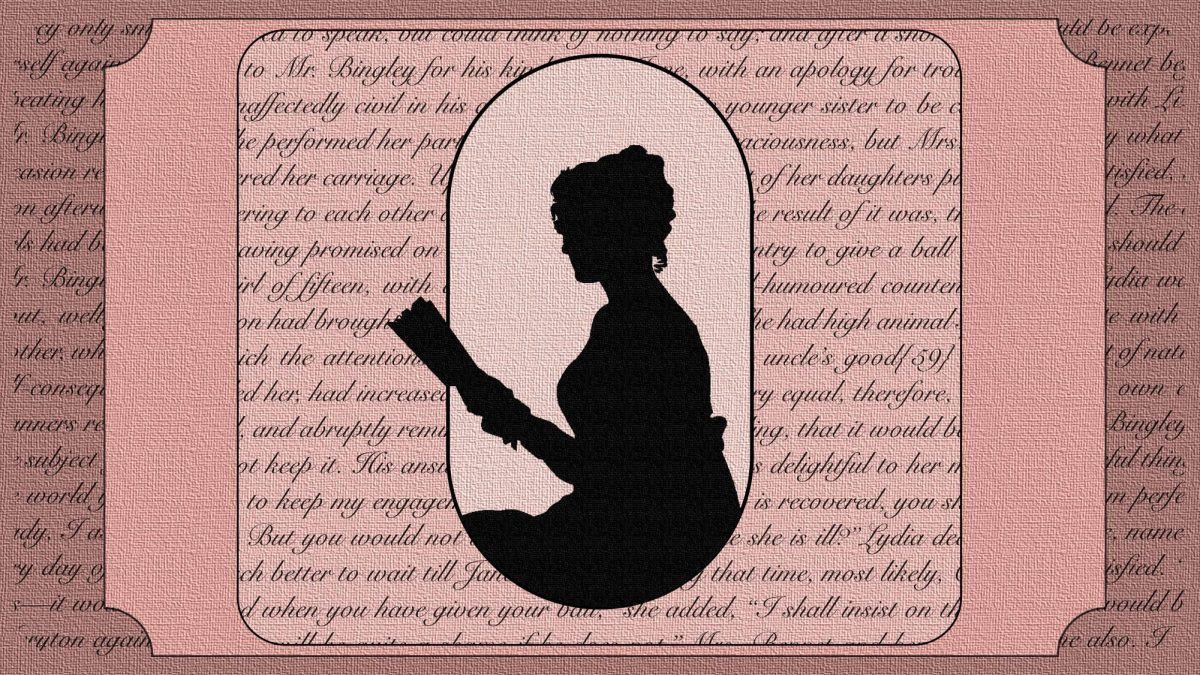
Jane Austen, a woman whose name became known through books, films and even through her own dialect of English during the Gregorian Period (“Austenspeak”), celebrated her 250th birthday last year. Her books, despite their age, have remained timeless with continuous film and novel adaptations in the 21st century. Austen, arguably, has left behind a profound impact on the literary world, centuries later.
BACKGROUND
Just the daughter of a humble clergyman, whose brothers were also in the church, Austen lived a quiet life as one of eight children. While being educated at home, Austen was given full, unrestricted access to her father’s library, quickly instilling in her a lifelong love of reading.
By age 25, Austen had written three notebooks full of stories (from ages 11-17), and completed manuscripts for “Sense and Sensibility,” “Pride and Prejudice” and “Northanger Abbey.” Her novels focused on love, but in messy, raw and realistic ways. They encounter humor and beauty, and tasteful feminism. Although most known for stories like these, she also wrote prayers for her family, complete in a book of her own common prayers. Although never published, the original manuscript with two pages of prayers can be seen in the Heller Rare Book Room of the F.W. Olin Library at Mills College.
AUSTEN’S LEGACY AT BIOLA
Here at Biola University, many professors have been deeply influenced by Austen and her works. Dr. Mark Makin, a professor of the Torrey Honors College, speaks on the influence she has had on him as a male teacher and student throughout the years.
From a personal level, Makin comments: “I was first introduced to Austen just through film adaptations…Pride and Prejudice, the classic six hour [BCC] version.” Makin went on to say that, through teaching Austen’s works in Torrey, he fell deeper in love with the books and the characters themselves.
As a male reading books by a female author with female protagonists, he was naturally drawn to the men in the books and their moments of growth. With each character, Makin noted that he was “struck by her moral clarity” through the virtue of these people who came alive on the page.
Makin was well aware of the scarcity of male fans when it came to Austen’s work. However, he was continuously drawn to the admirable qualities of these male protagonists, despite their flaws. Many of them were men he aspired to be, almost more so than the typical superhero that young men and boys look up to. Austen wrote her characters realistically, making them more impactful examples of men and women to her readers.
CONCLUSION
As someone who grew up with a mother who was (and is) a fan of all things Austen, I too fell in love with Jane at a young age. I was blessed to be introduced to her work first through the 2005 film adaptation of “Pride and Prejudice.” I was entranced, and even spent my early years of childhood flipping through pages of “Mansfield Park” and “Sense and Sensibility,” before I could even form full sentences.
By the time I was in high school, I was poring over these novels, particularly “Emma” and “Pride and Prejudice.” Her form of writing, “austenspeak,” can be quite overwhelming to consume in large quantities, but for someone who is a seasoned reader, reading an Austen novel feels as though it detoxes your mind and soul from the rather slang-ish style of modern language and writing.
Her work touched me since they were love stories that revealed the raw imperfections of these people, whose minds and souls seemed so real to me, that when I finished reading, it felt like heartbreak that Emma and Lizzy were not real, true women. And yet, their examples of humility, of love, of learned experience by sin and repentance, stirred within me an aspiration to live like these women. She presents a quiet desire to love, submit and be wise and independent, and to love and honor God in the subtle, quiet ways which Austen always hinted at.