Ryan Himes, an art major at Biola University, was drawn to Biola through the Torrey Honors College when he sat in on a session for the first time. However, the main attraction for him was the art department. Now finishing off his last year at Biola this spring, Himes focused on presenting his senior project, “Golgotha,” in the Green Gallery from April 20-24.
As he is a part of the bachelor of fine arts program, Himes explained that every student within the fine arts program is required to present a final show of their work in their senior year. This differs from art students who are in the bachelor of science program.
The goal of having a gallery is to potentially prepare the students for getting into the right headspace of holding future galleries themselves in the art world. This teaches them how to prepare their pieces, learn how to fill the space, set things up properly, etc. This type of show also differs from the animation major, recently added to the art program, where students showcase little shows and films they created through digital art and design. These are typically all showcased on the same day, whereas students with collections of art to showcase in the galleries have a few days individually within the space.
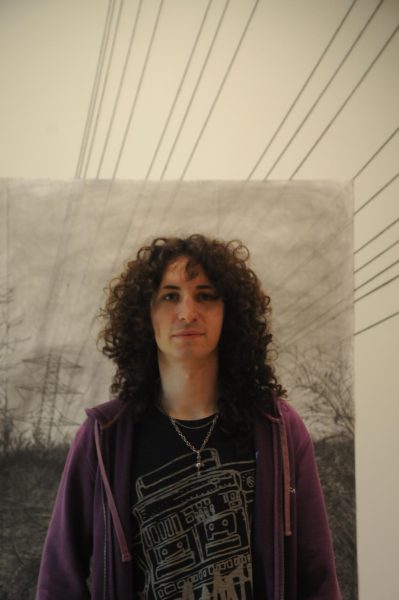
Himes states that it is almost impossible for him to decide on just one emphasis for his studies, “I like so many mediums, how do I choose?” His focus has loosely been drawn around illustration, including but not limited to digital, ink, charcoal and more.
He expresses many other interests and creative hobbies through his work, including crochet, which was something he spent a lot of last semester working on. “I’ve sort of grown in appreciation for different fiber arts.”
He also did a lot of work with clay, creating different sculptures to bring together his entire piece, as well as some screen printing work, bringing to life the desire he holds for this piece, from start to finish.
Himes’ idea for his senior project blossomed when he began to let his focus rest on the things around him, specifically powerlines. “I started to [realize] that this powerline sort of looked like a cross. And then I kept seeing that everywhere,” said Himes.
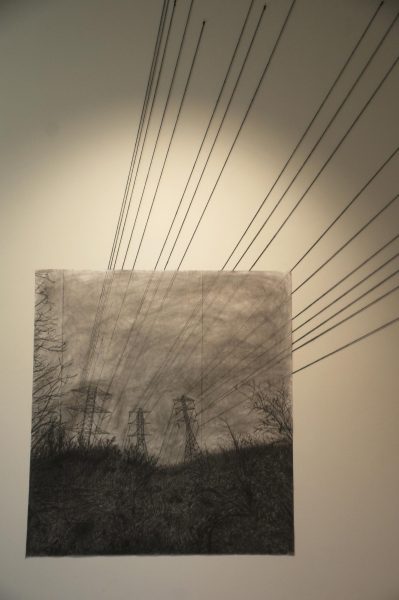
He began to recognize the beauty of everyday things, and more importantly, how they symbolize or point to something greater than their functioning simplicity. Himes stated, “I like this idea of being able to see something holy in something that’s, you know, ugly.”
He does not deny the lack of objective attraction and pleasure to the eye that these different items hold, and that is what presses him to find them beautiful, with almost a redemptive quality to them. Himes connects this type of beauty to the crucifix itself. “The crucifixion is, like, the ugliest of ugly scenes, but it’s also the beautifulest of beautiful scenes.”
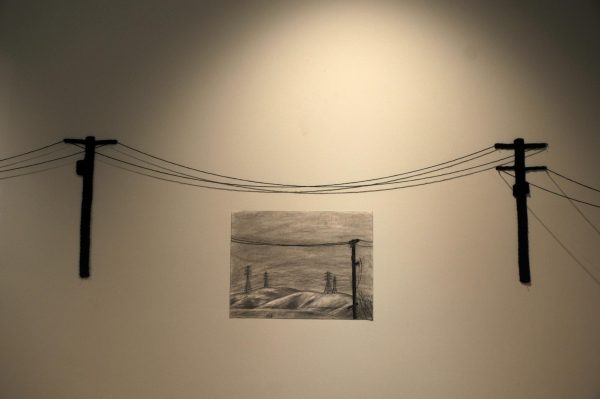
This is what Himes held in his mind when it came to creating this project. He found that his friends, and those close to him, began to send him photos of the different powerlines as they saw them, signifying the impact of his work and his desire to share the beauty in the not-so-beautiful. His hope for those who visited his show was that they would then be able to go into the world and, when seeing the sun shine through the trees, be able to sit in that moment and revel in the beauty of that specific moment in time, and then in response, point it back to God and glorify Him.