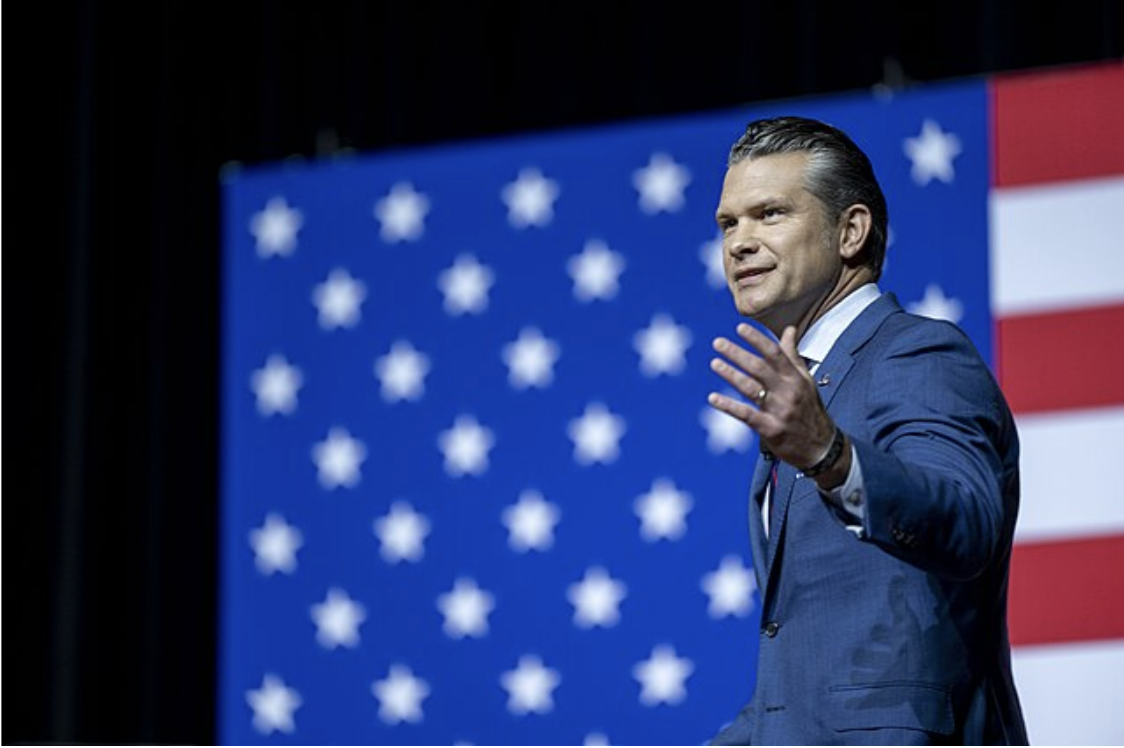
In a recent address given on Sept. 30th to hundreds of the top military leaders in the United States, Secretary of Defense Pete Hegseth announced multiple updates to military protocols and procedures. He detailed his plan to restore the military to its former strength, hoping to move the military away from what he deemed modern wokeness, to a more traditional understanding of what it means to serve America.
“This administration has done a great deal from day one to remove the social justice, politically correct, and toxic ideological garbage that had infected our department, to rip out the politics. No more identity months, DEI offices, dudes in dresses. No more climate change worship. No more division, distraction or gender delusions. No more debris,” he said. “As I’ve said before and will say again, we are done with that … I’ve made it my mission to uproot the obvious distractions that made us less capable and less lethal. That said, the War Department requires the next step.”
In this address, Hegseth stated that the Department of Defense–now the Department of War–had “lost [their] way” and ultimately, “became the woke department.” He explained that it is now his job to correct course and restore the military back to its former discipline, strength and unity.
Hegseth believes that the threats to America are ever-growing, and America must be prepared to defend itself, maintain peace and be equipped to win. This preparation entails restoring the “warrior ethos” to the military and having “the right people and the right culture at the War Department.” While many have argued whether or not Hegseth is correct in his assessment, veterans at Biola tend to agree. Although, they argue that the military never truly lost the culture of “warrior ethos.”
SPECIFIC CHANGES TO THE DEPARTMENT OF DEFENSE
With this strong rhetoric comes major changes to military policy. One of the first major changes was the renaming of the Department of Defense to the Department of War by an executive order from the President himself. Hegseth acknowledged this in his speech, saying, “the era of the Department of Defense is over.”
The goal of this change, according to Hegseth, is to remind the department and military of their primary mission: “warfighting, preparing for war and preparing to win, unrelenting and uncompromising in that pursuit not because we want war – no one here wants war – but it’s because we love peace. We love peace for our fellow citizens. They deserve peace, and they rightfully expect us to deliver.”
Another objective that Hegseth laid out is to restore the “warrior ethos” to the military. Throughout his address, Hegseth listed a number of changes he believes are necessary in order to accomplish this restoration. These changes include:
- Removing DEI policies.
- Instituting one standard of physical fitness and strength – ”the highest male standard only” – for both men and women.
- Requiring every member to take two Physical Training (PT) tests a year.
- Requiring all members to engage in daily PT.
- Reinstating common grooming standards: short hair and clean-shaven faces for all.
- Reshaping the Inspector General (IG), Equal Opportunity (EO), and Military Equal Opportunity (MEO) systems, so that military leaders can enforce rules and take disciplinary actions without fear of unfair complaints, pushback, or false accusations of hazing.
- Promoting officers based on merit and performance, not sex or ethnicity.
- Hiring new leadership in the department.
- Promoting unity over diversity, both in person and online.
Overall, Hegseth emphasized that those in the military are “professionals in the profession of arms.” As such, common standards of strength and unity must be maintained so that leaders can lead, America remains strong and lethal, and the military is able to properly deliver safety and justice to the American people.
“Standards,” he said, “must be uniform, gender neutral and high. If not, they’re not standards. They’re just suggestions; suggestions that get our sons and daughters killed.”
He ended his address with a prayer for the military, saying: “And most of all, Lord, please keep my soldiers safe, lead them, guide them, protect them, watch over them. And as you gave all of yourself for me, help me give all of myself for them. And amen.”
RESPONSE OF BIOLA VETERAN STUDENTS: GENERAL THOUGHTS
Veteran students at Biola had some thoughts about these changes announced by Hegseth. Multiple veteran students stated that some of these policies were already in place, just unofficially. While the official implementation of these policies is good, they did not predict it would result in drastic change to the military as a whole. Many agreed that, for the most part, Hegseth’s changes will be a benefit to the military. While they are strict, the strictness is proper to the job at hand.
“[Hegseth’s] policies are strict and it is a good amount of strict. During my time I believe some of these policies could have been a huge benefit for me,” said Matthew Montoya, a sophomore pursuing a Master’s in Pastoral Care and Counseling, and an Army veteran.
When it came to what Hegseth deigned as “wokeness” within the military, Biola veterans agreed that in their time serving they experienced external pressure to ensure equal opportunity for all, which resulted in double standards for troops. They also noted that some within the military did view many generals as being ‘woke’. However, they did not go so far as to label the military as a whole, ‘woke’. Rather, they noted that their day to day remained mostly unaffected, and they did not feel political pressure one way or the other.
As for the renaming of the department, the veterans agreed that, to military personnel themselves, the renaming wouldn’t make much of a difference. They said that while it may result in a slight attitude shift, the renaming is mostly semantics and won’t make any major impact.
“To me, it just sounds like a name,” said William Dodson, a junior political science major and former Marine. “Lots of government agencies and departments have been renamed many [different] things over the years. I think people on both sides of the issue, both those praising it and those taking away from it … would do better to focus on more important things.”
FITNESS STANDARDS
Regarding the new physical fitness standards, all were in agreement that these standards are a benefit to the military, especially when it comes to the fitness requirements for those in combat arms. Dodson explained that during his service as a machine gunner, his job required him to be stronger than an average Marine. Despite this, there were still moments when he felt challenged.
“There were times doing normal infantry things where my strength was tested to the absolute limit, especially when it came to doing things like having to carry your friend while he’s wearing full kit. You know that can easily top 200 pounds, and having to run with him while you have all your gear on,” Dodson said.
Dodson stated that many of the female Marines he knew, even those who were the most physically fit, could not accomplish the same tasks, or achieve the necessary results in training.
“It’s why we always joked that the second an extremely high intensity war starts again, everything about, like gender integration is going to go out the window, because we will learn in weeks that it’s a bad idea,” he said. “So yeah, I don’t think holding women to the same standards is a problem at all, because at the end of the day, it’s not a male standard or a female standard. It’s a Marine Corps standard. It’s an infantry standard. The job of an infantryman does not change whether it’s a man or a woman, so the fitness standard shouldn’t either. They’re expected to do the same things.”
Caleb Nestor, a second year of the Old Testament graduate program at Talbot and also a former Marine, expressed a similar sentiment. He stated that women who desire to serve in combat roles, within any branch of the Military, must necessarily be held to the same physical fitness requirements. “Their physical strength and endurance directly affect mission outcomes and the wellbeing of their counterparts,” he said.
“I don’t think that this rules out women,” Nestor explained. “In fact, I met plenty of women in the military that were excellent commanders and outpaced their male counterparts when it came to inspiring those underneath their command. However, I believe it does mean when combative operations rely on one’s ability to do physical tasks (e.g. hike X amount of miles with a 75-pound pack), out of necessity our egalitarian prerogatives ought to take a backseat.”
When it comes to other military roles though, such as those in administration or supply, Nestor stated that it is not necessary to hold women to standards that are quite so high. While they should still be held to high fitness standards that align with military expectations, jobs such as these don’t require the same level of physical exertion as combat roles. As a result, Nestor stated that here, the fitness standards should take into account the biological differences between men and women’s bodies, and what they are capable of.
Montoya agreed with these statements, but also added a caveat for higher military officials.
“I don’t agree that higher personnel [should] have to [be held to] specific, rigorous PT standards due to being in office,” he stated. “We can not take away that in the past they had the ability in war and a comprehensive understanding on executing mission essential conflicts. I believe this is more important than them being able to meet standards, and [they] shouldn’t be kicked out.”
GROOMING STANDARDS
On the topic of grooming standards, specifically as it relates to having a clean shaven face, the veterans agreed that these standards instill discipline and uniformity. They noted that, during their times of service, the most disciplined individuals in the military held themselves to high and professional grooming standards, even without the requirement in place.
“Enforcing things like appearance and grooming standards, it’s downstream of discipline, but it also instills discipline,” said Dodson.
Nestor expressed a similar sentiment, stating: “I know from personal experience that if you’re the kind of person who can’t hold themselves to the standard of shaving daily, you are relatively deficient in other aspects of your military career.”
Nestor did note that it is still important to maintain exemptions for individuals in specific situations. “[Hegseth’s] standards box out people with legitimate skin issues that prevent them from shaving every day. I think this is particularly antithetical to the “warrior culture” he is trying to propagate; whether one has a beard or not has no effect on their “warrior” capacity. In the past, one was allowed to have a beard if they had [a] religious [or medical] exemption,” he said. Without exemptions, Hegseth would be preventing qualified individuals from joining the military.
Montoya also brought up this point, saying: “The majority of people that would usually have beards were [African Americans], due to the skin condition that would erupt [everytime] they would shave their faces. Kinda seems targeted to them, and I [would] rather have someone who can perform than having someone who shaves but is trash in the battle field.”
DISCIPLINARY POLICIES
Some of the other policies Hegseth plans to implement deal with hazing and disciplinary policies within the military. He wishes for officers to no longer fear unfair criticism or false accusations of poor treatment or hazing from their troops. Biola veterans largely agreed that these policies are necessary, and will be of much benefit to the military. Multiple veterans talked about how, during their time of service, it was difficult to train and discipline troops without being accused of ‘hazing’ the troops.
Montoya explained that he personally had experience with this. In his service as a Sergeant, Montoya oversaw a group of 4 people, and was responsible for their training.
“It was very difficult and it felt like walking on egg shells trying not to get in trouble with the course of action that I was planning for them,” he said. “There wasn’t as much freedom to discipline their bad actions, but only having a form of paper telling them what they need to improve on. Which didn’t do much and the consistency of unmet standards continued, not only in garrison but also in the field.”
Dodson also recounted how the understanding of what ‘hazing’ was, shifted during his time of service. “The definition of hazing became very, very broad, and it stopped being in the eye of an observer, and it became in the eye of the participant,” he explained. Previously, hazing was understood to encompass activities such as physical abuse of troops, or alcohol consumption. However, Dodson explained that it eventually became “any kind of training that [caused] … stress or discomfort with the person being trained.” A trainee could run to the command with any complaint, whether legitimate or not.
Dodson said that this shift in meaning interfered with training, and resulted in troops feeling discouraged and underprepared. Dodson also witnessed the difficulties experienced by those in leadership positions. “I saw good Marines have careers ruined over this. I saw them get punished, get demoted,” he stated.
UNITY AND CONFORMITY
Overall, the veterans at Biola agreed that a sense of unity and conformity must be maintained within the military. Such values are core to its mission as well as necessary for its proper function.
“If someone wants to express themselves as an individual without qualification, don’t join the military,” stated Nestor. “You join the military to be a part of and to serve something bigger than yourself. There is space within that culture to be who you are, to be a person from where you’re from and with the culture that you were raised in, without it necessarily impeding uniformity. The military is itself a culture, one with its own ethos and prerogatives; therefore, when one joins, it ought to be understood that you are to adapt to that culture as much as reasonably possible without your personhood being destroyed.”
Dodson agreed, saying: “If somebody has a problem with uniformity, that’s fine, but they shouldn’t be in the military. They should be in a career field that respects … individuality and … unique expressions. They shouldn’t be in an organization of the federal government where you have a serial number and you’re an interchangeable part.”
CLOSING STATEMENTS
The veterans expressed that, regardless of what policies were in place before or during their time of service, they all would have chosen to still serve. Politics had little influence on their decisions to join. Rather, they wanted to serve their country the best way they could: with their lives. The question then was not if they were going to serve, but where they were going to serve.
Dodson and Nestor detailed how their decision to join the Marines was due to the traditionalism, pride and virtue exuded by the Marine Corps. The Marine Corps prepared its troops not only for warfighting, but also for an honorable return as better citizens to society. They saw the Marine Corps as being distinct from all other branches, and were subsequently drawn to its particular discipline and warrior spirit.
“I didn’t care about political policies,” said Nestor. “I was going to be a Marine.”