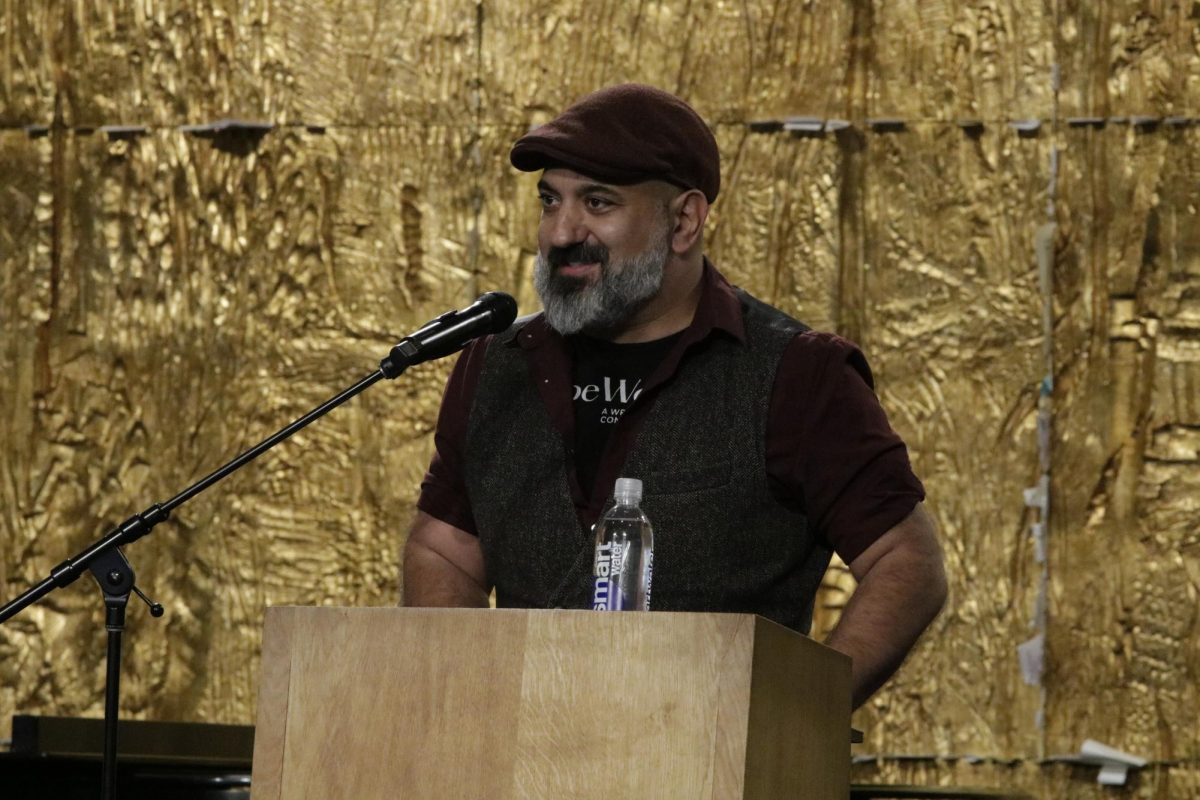
On Tuesday evening, Oct. 21, the Torrey Honors College hosted author Daniel Nayeri, who focused his lecture on the core concept of bravery—its meaning, daily application, and his personal journey as an immigrant in the United States.
Nayeri, an Iranian-born immigrant, arrived in the U.S. with his mother and sister as refugees after his mother converted to Christianity, bringing them to Oklahoma. Despite growing up differently, Nayeri persevered to become an award-winning author of several books, including “Everything Sad Is Untrue” and “The Many Assassinations of Samir.” His background shaped both his storytelling and his distinct Christian faith and humor.
During the lecture, Nayeri sought to answer the question, “What is bravery?” He described it as pressing forward in spite of fear.
“We’ve all heard better ideas of bravery,” he said. “Being afraid but still going forward? Inner strength to control your fear? This defines bravery as an internal focus of control, to have control over the mind.”
Nayeri commented that viewing bravery as just determination can cause people to falter. He explained it requires action, not just feeling. To illustrate, he shared Emily Dickinson’s poem “There is a Strength in Proving that it can be Borne”:
There is a strength in proving that it can be borne
Although it tear —
What are the sinews of cordage for
Except to bear
The ship might be of satin had it not to fight —
To walk on seas requires cedar feet
Nayeri believes that announcing oneself as brave is a poor indicator of genuine bravery. The real challenge lies in transforming feelings into decisive action and knowing which battles are worth engaging. This discernment is at the heart of true bravery.
Nayeri explained that the act of bravery, when properly used, is a subcategory of wisdom. Wisdom gives us the courage to discern between the battles in our lives and know when and why to act. He gestured towards modern culture’s emphasis on caution, which has conditioned people to favor safety over bravery, especially in parenting. Nayeri reflected on his childhood experiences and how parents would allow their children to venture far from home. Nowadays, children are only allowed to play within their parents’ line of sight.
Expanding on this point, Nayeri took it a step further, explaining how social media has contributed to this feeling of caution.
“It’s like I’m an animal in a lab,” he stated, “and they discovered a button in my brain labeled fear, and they keep pressing it and pressing it…But what if you spent the same amount of time looking for bravery on looking for wisdom instead? Wisdom tells us what direction to run.”
During times of crisis, Nayeri stated that people often revert to their training, what they practiced. He told a story of a father who instinctively shielded himself rather than his child during an avalanche. It wasn’t done out of evil but instead out of habit. He explained that in this situation, the father put himself at the center of his own bravery, thereby ensuring his own survival.
“Anytime I’m in a crisis,” stated Nayeri, “the people who show bravery are those who have habituated their minds on something above themselves… It is the only way to truly live, where the alternative is death.”
Nayeri calls us to build our bravery not upon ourselves, but on Christ, who provides the wisdom and love necessary for true courage. Bravery, he emphasized, is not a single dramatic act, but the result of daily faithfulness and disciplined love shaped by wisdom in Him.